
The real cost of managing social accounts in 12 browser tabs
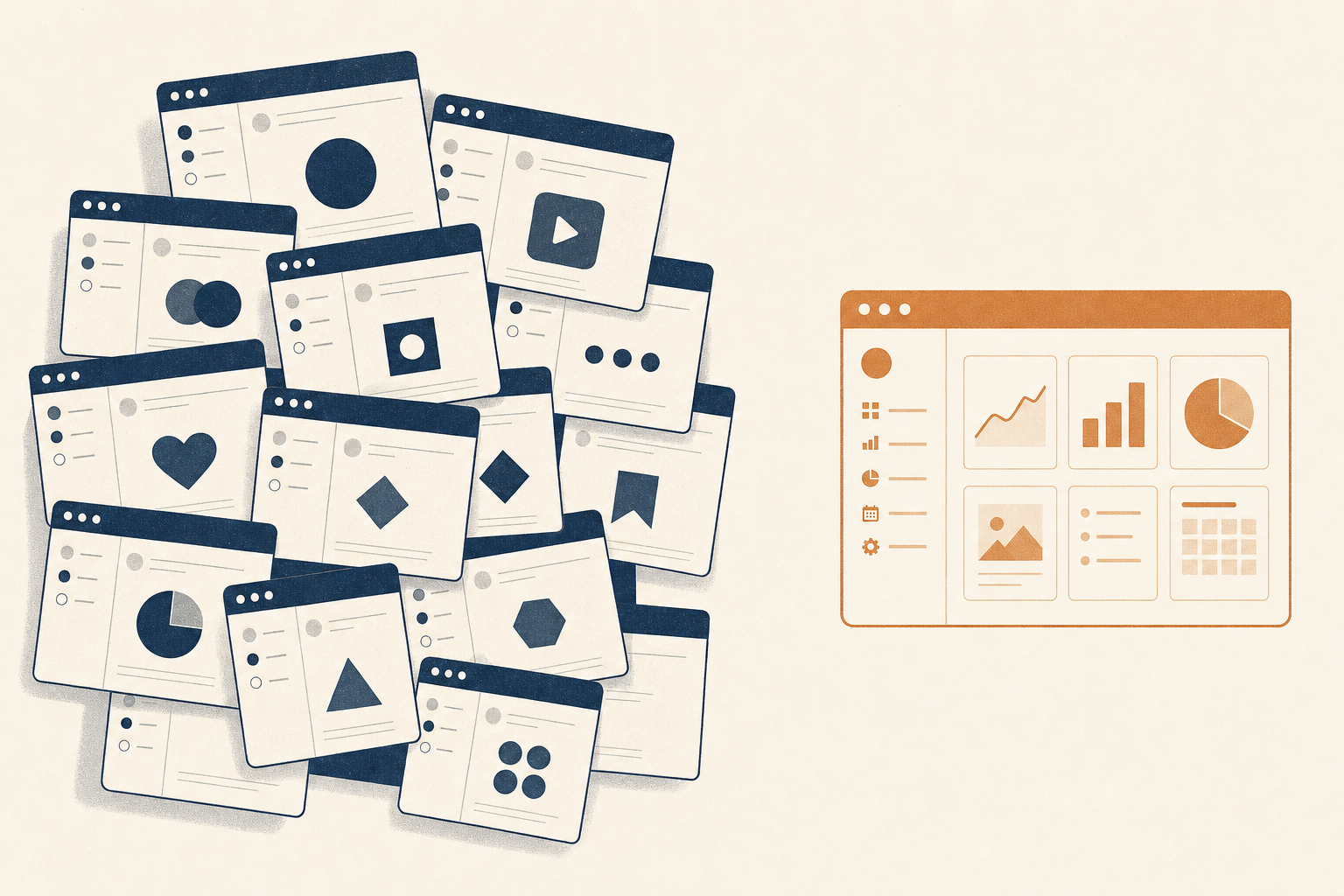
Open your browser right now and count the tabs. If you're managing more than one social account, there's a decent chance a few of them are Meta Business Suite, LinkedIn's page admin view, TikTok's creator dashboard, a scheduler for the accounts that tool supports, and a spreadsheet you use to track what's been posted where. None of those tools talk to each other. Each one is its own island with its own login, its own calendar, and its own idea of what "scheduled" means.
This is the default setup for most small teams running multiple accounts, and it works, in the sense that posts eventually go out. What it doesn't do is show up on a balance sheet anywhere, so nobody ever adds up what it costs. There's no invoice for tab-switching. There's just a slower week, and then another one, until it's normal.
Switching costs more than posting does
Writing one post takes a few minutes. Writing 12 versions of one post across 12 tabs doesn't take 12 times as long, it takes longer than that, because every switch between tools resets your head. You log into Instagram, remember what you were doing, write the caption, resize the image because Instagram wants something different than LinkedIn does, post it, then start over completely in the next tab with a different interface, different character limits, and different upload requirements.
None of that switching cost shows up as a line item anywhere. It shows up as a Tuesday afternoon that somehow disappeared, and a nagging sense that social media management takes far more time than the actual output would suggest it should.
The knowledge that walks out the door
There's a version of this cost that only shows up when someone leaves. If one person has been managing 8 accounts across 6 platforms from their own logins, their own bookmarks, and their own mental map of what's posted where, all of that knowledge leaves with them. The next person starts from zero: requesting access to each platform individually, guessing at what the posting schedule was supposed to be, and often discovering an account nobody remembered existed because it was never written down anywhere central.
This isn't hypothetical for agencies specifically, but it hits them hardest, because client accounts are exactly the kind of thing that shouldn't depend on one person's browser bookmarks. A client doesn't care that the person who knew their Instagram login just gave notice. They just notice the account went quiet for 2 weeks during the handover.
What gets lost in the shuffle
A few things happen reliably when accounts are managed one tab at a time, and none of them are dramatic on their own. They just add up.
- Posting cadence gets uneven. Accounts that are easy to log into get posted to often. Accounts buried in a bookmark folder go quiet for weeks at a time, not because nobody cares about them, but because logging in is friction and friction wins on a busy day.
- Nobody has a shared view of what's already scheduled. Two people on the same team can both queue up content for the same account on the same day without knowing it, because there's no single calendar either of them can check first.
- Comments and DMs get missed. If you're checking 6 separate inboxes across 6 separate apps, the ones that don't get checked daily accumulate unanswered messages, and a slow reply on social media reads the same as no reply at all to the person waiting.
- Reporting becomes a copy-paste job. Pulling a "how did last month go" summary means logging into each platform, screenshotting or exporting numbers, and manually building a table that's out of date the moment you finish it.
Each of these is survivable in isolation. A missed DM here, an uneven posting week there. But they compound, and the accounts that suffer most are usually the smaller or newer ones, exactly the accounts that need consistency the most to build any traction at all.
There's also a quieter cost: decision fatigue. Every login is a small decision point where it's easy to think "I'll do this one tomorrow instead," and tomorrow that same decision gets made again. None of these choices feel significant in the moment. A week later, one account has posted daily and another hasn't posted in 9 days, and nobody consciously decided that should happen. It's just what 12 separate logins nudge you toward when one of them is always slightly more annoying to open than the rest.
Why "just add another scheduler" doesn't fix it
The obvious next move is to grab a scheduler. Most do genuinely help with the core problem: queue up posts across platforms from one screen instead of logging into each one separately. But a lot of the tab-switching cost was never really about scheduling. It was about everything scheduling tools historically leave out.
Comments and DMs, for a start. Plenty of schedulers publish content and stop there, so the inbox chaos stays exactly as it was, just with one less tab for posting and the same 6 tabs for replying. Boosting a post with paid spend is another gap: a scheduler that only publishes organically means jumping into Meta's ad tools separately the moment a post is worth putting money behind, and by the time you've done that the organic momentum has often already faded. Reporting across accounts is a third: a scheduler that shows you each account's numbers one at a time hasn't solved the "which segment is winning" question, it's just moved the copy-paste job from 6 platforms down to 6 scheduler tabs instead.
None of this is a knock on scheduling as a category. It's the reason the actual fix isn't "a scheduler" so much as "one operating layer that covers posting, replying, boosting, and reporting together," because splitting those four across separate tools just recreates the original problem one layer up.
A rough estimate, not a stat
Nobody has good data on this because nobody tracks it, but it's worth doing the arithmetic once. Say you're running 5 accounts across 4 platforms. Writing and posting one piece of content per account per day, with logins, resizing, and platform-specific tweaks factored in, realistically costs 10 to 15 minutes per destination once you include the switching overhead, not just the typing. That's roughly an hour and a half to two hours a day, every day, just for posting. Add in checking inboxes across those same platforms and you're well past two hours before a single piece of strategy work happens.
Scale that to 15 or 20 accounts, which isn't unusual for an agency managing several clients, and the math stops working. There aren't enough hours in a day to give each account the individual attention a single browser tab requires, so something gets cut. Usually it's consistency, then engagement, then reporting, roughly in that order, because those are the tasks that feel most skippable in the moment even though they're the ones that determine whether an account actually grows.
The scheduling collision nobody plans for
Even teams that do use a scheduler often hit a version of this problem one level up: the scheduler handles one account fine, but has no concept of a shared calendar across accounts or across team members. Two campaigns get queued for the same day without anyone noticing until both go out at once, and a follower sees the same brand post twice in an hour, or an audience that was supposed to get a steady drip gets nothing for 10 days and then 4 posts in one afternoon.
A shared day-occupancy view fixes this at the source. If every path into the calendar (manual posts, bulk scheduling, automations, retries) checks the same shared map of what's already committed for a given day, collisions like this stop happening by construction, not because someone remembered to check first.
What one dashboard actually buys back
The fix isn't "try harder to stay organized across 12 tabs." It's removing the tabs. One login, one calendar, one place to write a post once and have it tailored automatically for each platform's format, character limit, and post type. The time that used to go into re-typing the same caption 5 different ways goes into writing it well once.
The same consolidation fixes the inbox problem. Comments and DMs from every connected account land in one place, with unread badges that make it obvious what's been sitting unanswered instead of buried in a tab nobody opened this week. And reporting stops being a manual export job, because the numbers are already sitting in one dashboard instead of scattered across platforms.
What this frees up time for
The honest case for consolidating isn't just "it's faster," though it is. It's that the hours clawed back from tab-switching and manual copy-paste are hours that go somewhere. For a solo operator, that's the difference between social media eating your whole afternoon and having 30 minutes left over to actually think about what to post instead of just getting it out the door.
For an agency, it's the difference between a junior team member spending their day logging into and out of client accounts, and that same person spending their day writing better content, because the mechanical parts of the job (destination routing, format checks, posting caps, reply triage) are handled by the system instead of by memory.
None of this requires posting more. It requires the same output, without losing an afternoon to the plumbing every time you sit down to do it.
Two Tuesdays, side by side
Picture the same person running 6 accounts across 4 platforms, one Tuesday managed the old way and one managed from a single dashboard.
Old way: log into Instagram, write and resize a post, log out. Log into Facebook, do the same with slightly different dimensions. Log into LinkedIn, rewrite the caption because the tone that worked on Instagram reads wrong there. Check TikTok separately for comments because there's no unified inbox. Somewhere in the middle of all that, remember there's a client call in 20 minutes and lose the thread on what was scheduled for tomorrow. By the time all 6 accounts are covered, close to 2 hours have gone, and the inboxes still haven't been checked properly.
Consolidated way: write the post once, review the per-platform variants the system already tailored, adjust anything that reads wrong, and publish to all 6 destinations from one screen. Check the single unified inbox for anything unread across every connected account. Glance at the shared calendar to confirm nothing's double-booked for tomorrow. Same output, same 6 accounts, closer to 30 minutes, with time left over to actually think about what next week's content should say instead of just getting today's out the door.
Nothing about the second version requires posting less or caring less. It just removes the parts of the job that were never really about the content in the first place. Multiply the difference across a week, across a team, across every account someone's responsible for, and it stops being a minor convenience and starts being the reason one operator can cover what used to take two people.
The tell that it's time to consolidate
If you've ever finished a week of social media management and couldn't say how many posts went out, what got missed, or how any of it performed, that's a tooling problem, not a discipline one. Twelve tabs are twelve separate, unconnected workflows that happen to share your attention, and attention split twelve ways gets thin fast.
The businesses that get consistent, reliable output across multiple accounts aren't the ones with more willpower. They're the ones who stopped managing accounts one tab at a time and started managing them as one operation.
The tabs were never the actual job. Writing something worth posting, replying to the people who engaged with it, and knowing what worked well enough to do more of it, that's the job. Everything else was overhead that crept in because the tools never talked to each other. Close the tabs, keep the work.