
How many social accounts should your business actually run? A framework
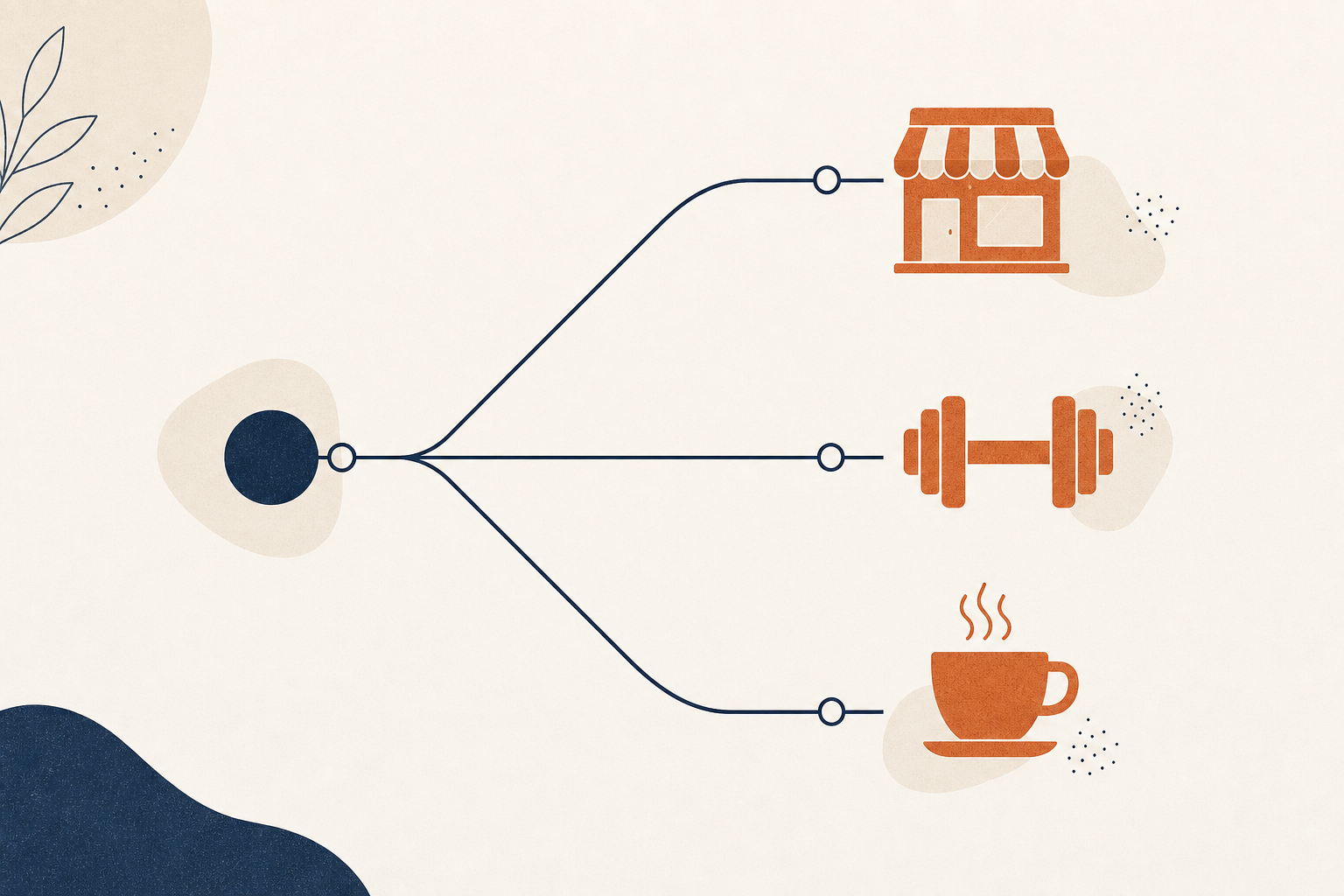
There's no universal right number of social accounts for a business to run. One is right for some businesses. Twenty is right for others. The real mistake is picking a number without a framework: defaulting to 1 because that's what everyone starts with, or splitting into 10 because it sounds ambitious, without checking whether either choice fits how the business actually serves customers.
Here's a framework that works from the audience outward instead of guessing at a number first.
Step 1: list who actually buys from you, not who you sell to in theory
Start with real segments, not aspirational ones. A gym might sell to "everyone who wants to get fit," but the people who walk through the door split into distinguishable groups: serious lifters who care about programming and equipment, casual members who care about class variety and community, and corporate wellness accounts who care about billing simplicity and reporting for their HR department. Three different reasons to buy, from the same business.
Write these down as a real list, not a demographic guess. If you're not sure, look at your last 20 customers and group them by what made them buy, not by age or location. The groupings that fall out of real behavior are almost always more useful than the ones that come from a marketing persona template.
Two customers who look identical on paper (same age, same location, same job title) can buy for completely different reasons, and two customers who look nothing alike on paper can buy for exactly the same one. Demographics describe who someone is. This exercise cares about why they showed up.
Step 2: for each segment, ask if the content genuinely diverges
Having 3 segments doesn't automatically mean 3 accounts. The test is whether the content each segment wants to see is different enough that combining them dilutes both. Serious lifters want programming detail and equipment specifics. Casual members want to see the vibe of a class and hear that they won't be judged for showing up out of shape. Those two audiences reading the same feed either both feel slightly misserved, or one dominates and the other stops paying attention without ever complaining about it.
Corporate wellness accounts are a different case: they might be the same audience as casual members in terms of content interest, just reached through a different sales channel (HR benefits platforms, not social media at all). Not every segment that exists needs a social presence of its own. Some are better served through a channel other than social entirely.
A quick way to score each segment
If listing segments by feel isn't giving a clear answer, score each one on 3 questions: does this audience buy for a clearly different reason than the others (yes/no), is there enough distinct content to feed an account monthly without straining (yes/no), and does this audience spend meaningful time on a platform the business could realistically show up on (yes/no). A segment that scores yes on all 3 is a strong candidate for its own account. A segment scoring yes on 1 or 2 is probably better served folded into a broader account, tagged separately so it can be split out later if it grows.
This turns a fuzzy "does this feel like a different audience" judgment call into something closer to a checklist, which matters most when a team disagrees. Founders often want to split further than the data supports, because every segment feels important from the inside. A simple scoring pass keeps that instinct honest.
Step 3: check if you can sustain the content each split would need
A account only helps if it can be kept alive. Splitting into 5 accounts and only having enough content ideas for 2 of them consistently produces 3 abandoned-looking profiles, which damages trust worse than never having split in the first place. A quiet, inconsistent niche account reads as "this business doesn't care about people like me" more than a shared general account ever would.
Before committing to a split, sketch out one month of content ideas for the proposed new account. If you can list 15 to 20 distinct posts without straining, the audience is specific enough to sustain its own presence. If you're stretching to find more than 5 or 6 unique angles, that segment probably isn't distinct enough yet, or the business doesn't have enough happening in that niche to feed it regularly.
Step 4: weigh the platforms each segment actually uses
The 5-channel, 10-segment math (50 destinations) assumes every segment needs every platform, which is rarely true. Serious lifters might live on Instagram and YouTube for form checks and programming content, and be almost absent from Facebook. Corporate wellness contacts might be reachable on LinkedIn and nowhere else that matters. Mapping segments against the platforms they use narrows the real destination count significantly, and stops you building out accounts on platforms that specific audience never checks.
This step alone often cuts a theoretical 50-destination plan down to something closer to 15 or 20 real ones, because most audiences don't split their attention evenly across every platform a business happens to be present on.
Step 5: decide what stays together on purpose
Some segments should share an account even after all this analysis, not because splitting them is too much work, but because keeping them together is the right call. A small business with 2 mildly different customer types and limited content bandwidth is often better served by 1 well-run account than 2 thin ones. Use the framework to make the decision deliberately, not as a mandate to split as far as possible.
Who should run this framework, and how long it takes
This doesn't need a consultant or a multi-week strategy sprint. It's a half-day exercise for whoever already knows the customer base best, usually the founder or head of sales for a small business, or the account lead for an agency working through this on behalf of a client. The inputs are things that person likely already knows: who actually buys, why, and what they respond to. The framework's job is turning that existing knowledge into a structured decision instead of a gut call made under time pressure.
Run it as a working session, not a solo desk exercise if possible. Someone in sales or customer support often has sharper instincts about how segments actually differ than whoever's been managing the social accounts, because they're the ones hearing the actual objections and questions from each type of customer. Bring both perspectives into the room before finalizing a number.
What to do with a borderline segment
Some segments will land right on the line: distinct enough to feel worth splitting, but not clearly enough to score a confident yes across all 3 questions. For those, the lower-risk move is usually to tag the content within an existing account rather than launching a separate one immediately. Write content for that segment, tag it distinctly, and watch how it performs relative to the rest of the account for a month or two.
If tagged content for that segment consistently outperforms the account average, that's real evidence the audience is distinct enough to justify its own presence, and splitting it out later is a much safer decision than guessing up front. If it performs about the same as everything else, the segment probably wasn't as distinct as it felt, and staying combined was the right call all along.
A worked example
Take a business selling a booking tool to both hair salons and barbershops. On the surface that's one vertical (personal grooming services). Run the framework: the audiences buy for different reasons (salons care about client history and consultation flow, barbershops care about walk-in speed and simple pricing), the content clearly diverges (before-and-after color work reads nothing like a fast fade queue), there's enough content for both to sustain their own accounts, and both audiences are reachable on the same 2 or 3 platforms.
That's a clean case for 2 accounts, not 1. Compare that to a business selling the same tool to hair salons in 2 different cities. Same audience type, same content needs, just different locations. That's usually a case for 1 account with location-specific posts folded in, not 2 separate ones, unless the locations are large enough and different enough in local culture to justify the split on their own.
What too many accounts actually costs
It's worth being honest about the downside of over-splitting, because the framework only works if both directions carry real weight. Every account added is another surface that needs replies, another set of numbers to check, another thing that can go quiet and look neglected if attention gets stretched too thin. A business with 8 accounts and enough content and attention for 4 isn't running a fleet, it's running 4 healthy accounts and 4 liabilities that happen to have a login.
The failure mode of under-splitting is a diluted account that converts worse than it should. The failure mode of over-splitting is a scattered set of accounts, several of which look abandoned, which damages trust with exactly the audience segment that account was meant to serve. Neither failure is better than the other. The framework exists to avoid both, not to push toward more accounts as a default good.
What too few accounts actually costs
The opposite failure is easier to miss because it doesn't look like a mistake, it looks like normal operation. One account serving several clearly different audiences underperforms across the board, with no obvious single moment where something visibly broke. There's no crisis to point at, just a follower count that grows slower than it should and an engagement rate that never quite gets good, because the content is permanently hedging between audiences instead of speaking clearly to any one of them.
This is why running the framework matters even for a business that's never had a problem with its current setup. "Nothing's obviously broken" and "this is optimally structured for who buys from us" are different claims, and only one of them shows up in a quarterly report.
Revisit the number as the business changes
The right number isn't fixed forever. A business that starts with one clear audience might need to split as it expands into new verticals or regions. A business that split too early might need to fold 2 quiet accounts back into 1 stronger one if neither ever built real traction alone. Run the framework again whenever the business changes shape (a new product line, a new geography, a stalled account that isn't earning its keep) rather than treating the original account structure as permanent.
What makes this manageable once you've decided
The number itself only becomes a real headache if the tooling behind it doesn't scale with the decision. Tag-based routing (accounts and content connected by a live relationship, not a folder-based grouping) means growing from 3 accounts to 8 later doesn't require rebuilding anything. The framework tells you how many accounts to run. The tagging structure is what keeps that number from turning into 8 separate, hand-managed projects once you get there.
That's worth internalizing before running the exercise, not just after: the cost of running more accounts drops significantly once the routing is handled by tags instead of by memory, which means the framework's answer should lean on what the audience actually needs, not on how much manual overhead the team can absorb. A tool that makes 8 accounts as easy to run as 1 changes what the right number looks like in the first place.